
AI has quickly and quietly become one of the most useful tools for travel planning. At Polarsteps, we build tools used by millions of travelers to plan and track their trips, and we’ve seen firsthand how AI can shape better itineraries (and where it falls short).
Here’s what works, what doesn’t, prompts to get you started, and what to watch out for while using it.
How to use AI to pick a travel destination
AI can filter the entire world of possible destinations through the lens of exactly who you are as a traveler and what you’re looking for in that moment, but you’ll need to be specific to get the best results. Here’s what to put in your prompt:
Tell it what excites you: food, history, nightlife, remote landscapes.
Mention what you’d rather avoid: crowds, driving, social media hotspots.
Share trips you’ve taken before and what you did or didn’t enjoy about them.
Tweak this prompt to match your own interests and get inspired to plan your next trip:
I'm planing a hiking trip this summer.
I want: challenging terrain, 20–30km circular/out-and-back day hikes from a single base, minimal crowds, affordable accommodation, access by train from Amsterdam, Netherlands.
I do not want: social media or tourist hotspots, a multi-day route, or to have to rent a car.
I traveled to Grindelwald in Switzerland last year and loved it. The landscapes were incredible and the train links were really convenient, but gondola tickets and eating out were too expensive.
Can you suggest some destinations that would be a match for me?
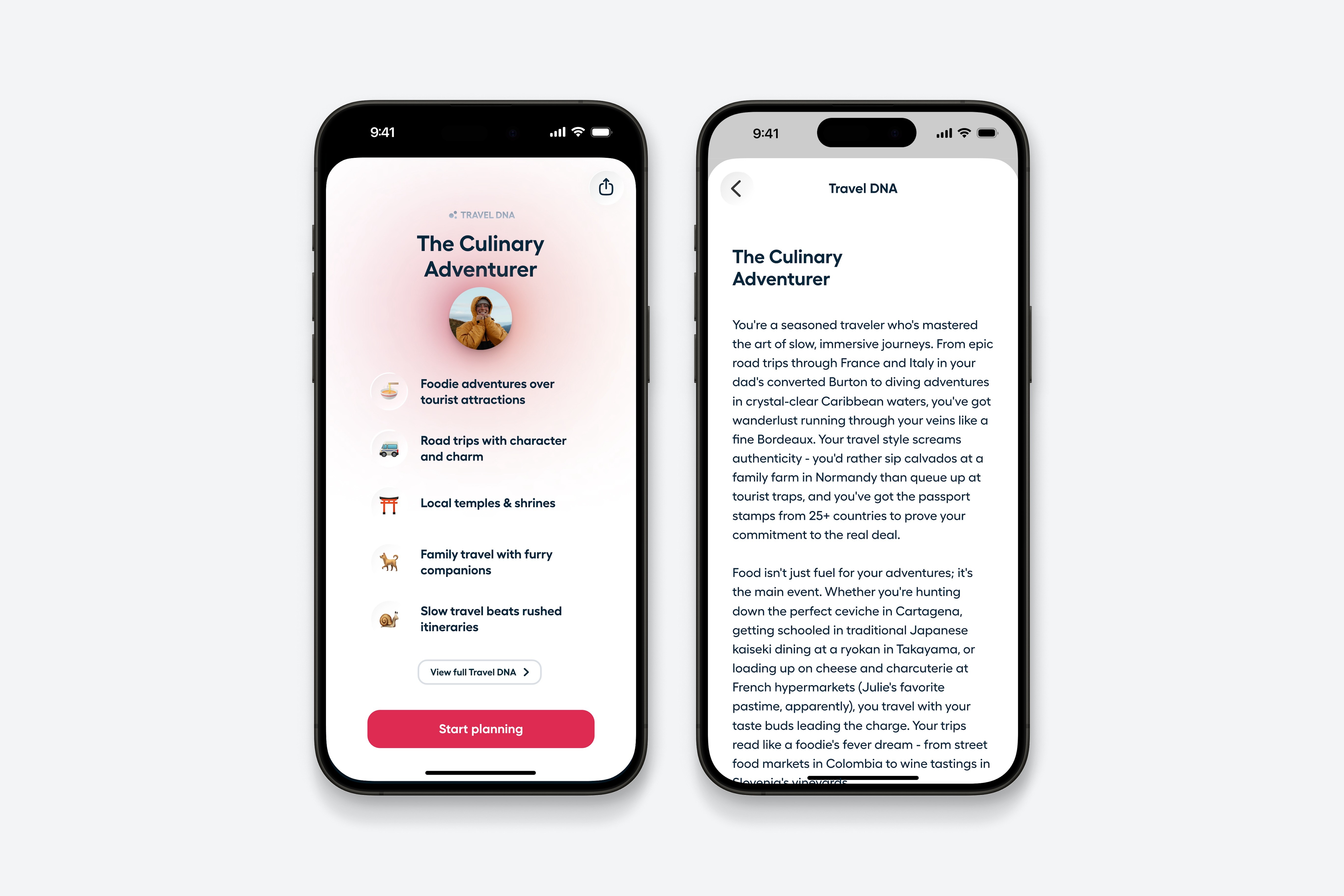
Using the Polarsteps AI Trip Planner puts you a step ahead. Given permission, it draws on your previously tracked trips to identify your travel style — your Travel DNA — and uses this as a starting point for customized itineraries, so you're never starting from scratch. |
|---|
How to use AI to create a travel itinerary
Once you’ve decided on a destination, use AI to craft a custom itinerary quickly and efficiently. At this stage, you can be as specific or as open-ended as you like, from exact experiences to broad themes like adventure, culture, or nature. Start building your route with these basics:
Where you’d like to go
How long you plan to travel for
What you’d like to see or experience there
Your travel preferences (overland transport only, road trip, etc.)
Edit this prompt as required to generate your own itinerary:
I want to visit Vietnam for three weeks in February. My plan is to fly into Hanoi and out of Ho Chi Minh City. I’d like to sail around Ha Long Bay, go hiking in the mountains, visit the caves around Phong Nha, and try sandboarding in Mui Ne. I’m considering Ninh Binh and Hoi An too but would prefer less popular alternatives. Please create an itinerary using only overland transport with as little backtracking as possible.
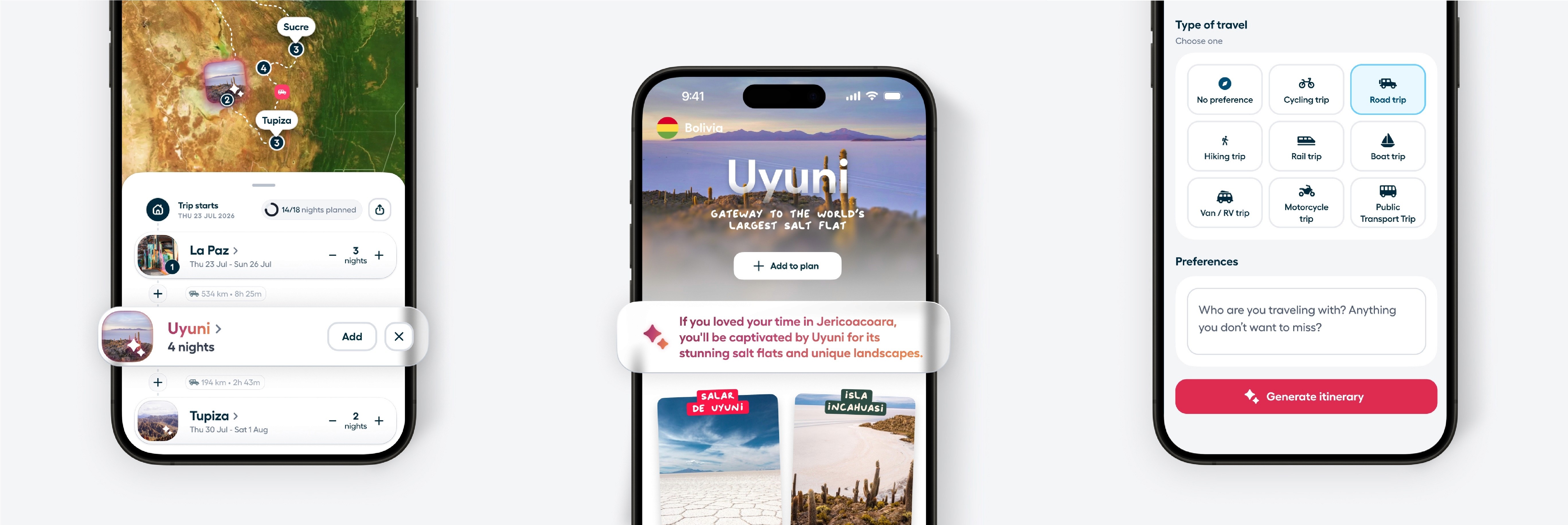
From this first iteration, you can refine your route by asking AI for more details about each of its choices. Polarsteps packages up this process into a visual interface, allowing you to browse, add, and edit destinations with tailored AI insights.
Before you dive into the details of planning your trip, ask AI to check two major things: seasonality risks and visa requirements.
Feed AI your planned route and travel dates and ask it the following questions:
How might the season affect my experience of traveling in this country at this time of year?
What are the visa requirements for someone of my nationality visiting this country?
The answers to these questions will raise any potential issues that could impact your adventure before it even begins, from public holidays affecting transport links to adverse weather washing things out.
How to use AI for detailed travel planning
With your route locked in, use AI’s working memory to keep track of all your travel planning without having to juggle bookmarks and spreadsheets. Its parallel processing abilities can store, recall, and compare information easily, or turn a broad set of inputs into specific, actionable lists. Here’s how to make that useful.
Transport and accommodation bookings:
Ask AI to map your itinerary onto a calendar to easily manage your bookings. Ask it for recommendations as you work through each stop on your trip, and use it to keep a clear sense of any decisions still to be made.
I need to book accommodation for each stop on my itinerary, plus transport between each location. Please create an overview checklist that I can use to quickly reference what’s booked and what’s still to plan.
I’m looking for hostel accommodation in Hanoi. It has to be central and available for my specific travel dates. The vibe should be more relaxed than party-focused. What are my best options?
I’m traveling to Sa Pa from Hanoi on February 26. What are my transport options? Cheaper is better, and I’m open to overnight travel.
Tip: Whenever you make a booking, share the confirmation with AI to keep track of booking codes, seat numbers, check-in, and departure times. |
|---|
Packing:
Use AI to make tailored packing lists that take every aspect of your trip and travel style into account. Start by telling it the following:
Your destination
Time of travel (exact dates or time of the year)
Planned activities
Luggage allowance (20kg checked bag, carry-on only, etc)
Add the brand and size of your bag for even more detailed advice:
I'm traveling to Japan for two weeks in late March, arriving in Tokyo and leaving from Osaka. I'll be doing a mix of city exploring and hiking, including one or two multi-day trails. I'm traveling with a 40-liter Osprey Farpoint only. Please build me a packing list based on the forecast conditions, planned activities, and bag size, and suggest a packing strategy to maximize space.
If you’re struggling to fit everything in, ask AI to help you make smart edits. It can identify your most versatile items to help you piece together outfits, and even suggest when it makes the most sense to do laundry during your trip.
How to use AI for in-the-moment travel planning
Once you're out in the world exploring an unfamiliar place, AI can help you make decisions at a moment's notice to avoid walking around in circles feeling lost or unsure.
If you’re hungry, tell it where you’re standing or share your live location, how much time you have, and what kind of cuisine or meal you’re in the mood for.
If you’re looking for something to do, ask which sights or museums are nearby and open to visit, or if there’s a hiking route that you can complete before dark.
If something is unclear, such as directions or local etiquette, ask AI to fill you in. It can confirm that you’re on the right bus, or if there are any cultural requirements for entering the temple you just found.
If you’re sick, use it to access local emergency numbers, locate the nearest hospital or pharmacy, or communicate with medical professionals in a foreign language. It’s also worth brushing up on a few general safety tips before your trip.
If you’re traveling solo, use it to sense-check decisions like where to go next, how to get there, or what’s worth your time.
What to watch out for when using AI for travel planning
AI is useful for travel planning, but it has its limitations. Here are its most common pitfalls and how to navigate them:
Outdated information
AI models are trained on data up to a certain point, which means they can confidently recommend a restaurant that has since closed, quote transport connections that no longer exist, or miss recent developments like trail closures, new visa rules, or regional disruptions.
The fix: Search for the same information on a different platform to evaluate credibility, or check how recent the source is. For restaurants and museums, check the most recent review dates on Google, Yelp, or similar.
Incorrect directions and journey estimates
AI can suggest routes and directions, but it lacks spatial awareness. It can underestimate overland journey times, particularly in regions where road conditions, border crossings, or infrequent connections add significant time to a route.
The fix: Cross-check journey times against similar tools like Google Maps, Rome2Rio, or Waze, and avoid using AI for on-the-ground navigation. For a full breakdown of the tools we recommend alongside AI, see our guide to the best travel apps in 2026.
Generic recommendations
AI has a tendency to favor well-known sources and popular destinations, so recommendations can suffer from popularity bias and contribute to overtourism.
The fix: Use highly specific prompts with ‘negative constraints’ (things to avoid specifically, like recommendations from ‘Top 10’ lists), or direct AI to niche online spaces such as Reddit. You can also feed in ideas like these adventurous alternatives to swamped tourist sites to get more original recommendations.
Lack of real-time context
AI won’t factor in things like wildfires, political unrest, or sudden transportation strikes into its recommendations.
The fix: Check local news outlets in the area where you’re traveling before you go.
Hallucinations
AI can generate information that sounds completely plausible but is entirely made up, prioritizing fluency over accuracy.
The fix: Treat any specific claim — names, dates, addresses, prices — as unverified until you've checked it against a reliable source.
Download Polarsteps to discover your Travel DNA and build a custom AI itinerary for your next adventure. |
|---|
Cover image: Jheng-Da Chen/Unsplash

Matt Bainbridge
Senior Travel Editor


